
Digital Project Intake
2026, Samantha Cole
An adventure in digital transformation, project management, and high-speed process architecture.
The Opportunity
During my time as a Marketing Operations Manager, focusing on Marketing AI Enablement, I was tasked with identifying opportunities for AI adoption across the Marketing organization. Upon speaking with the Creative & Content Operations team (hereafter referred to as “CC Ops”), their challenges resonated with me as a need for process development and digital transformation, while incorporating AI where it could make a meaningful difference.
The Process
Through my experience and education in strategic leadership and change management, I knew that a clear objective and project plan were key to success.
Step One: Discovery
While I had my own ideas for improvements, it was important to keep the key stakeholders top of mind:
The CC Ops team, whom we were solving for, would ultimately be impacted by the change in process.
Their stakeholders, who were requesting work via this process or further downstream in the project workflow.
Leadership, who would need visibility into KPIs and improvements.
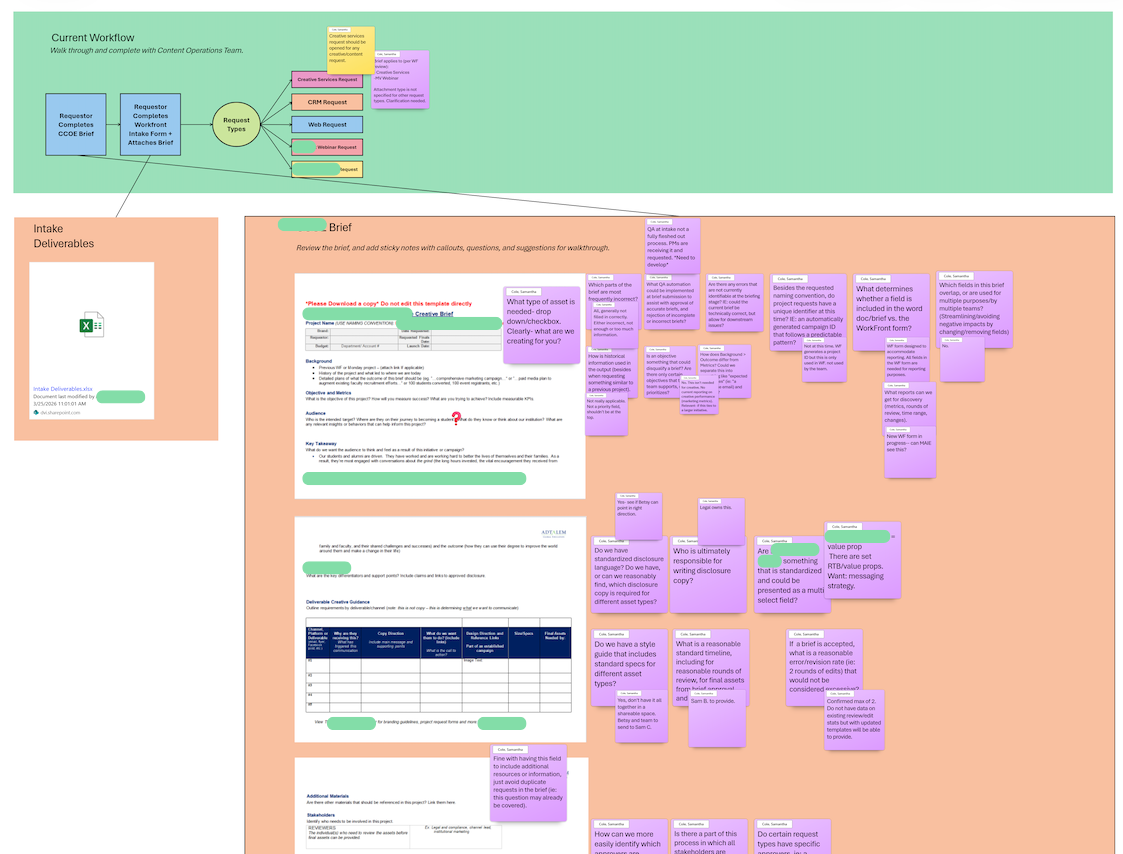
My first step was to map the current process and get feedback from the CC Ops team to determine what was working and what was lacking.
Using Microsoft Whiteboard, which was the collaboration tool available to me, I created a workspace for a discovery session. A portion of this is shared, highlighting the initial process map and intake brief, with my thoughts and questions for discussion with the team.
The Main Challenge
The brief in its existing form, a Word Document completed by the requester and attached to a Workfront project request, was not clearly communicating what the CC Ops team needed to do.
The current process did not allow for predictable timelines due to the rate of churn and revisions.
The team did not have visibility into the impact of their work, due to a lack of reporting.
Step Two: Design the Solution
Standardization is an absolute requirement before automation, and because we were starting with a Word Document as the source of the truth, we had plenty of opportunity to standardize. Some highlights that I identified included:
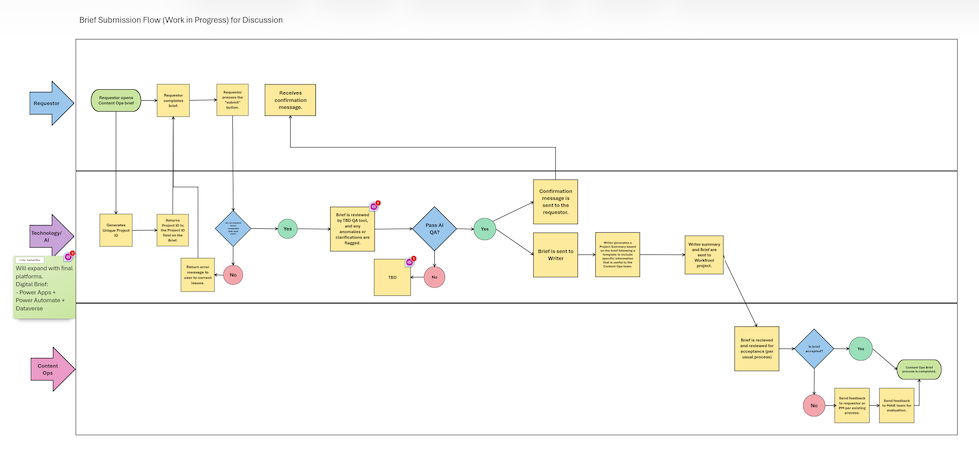
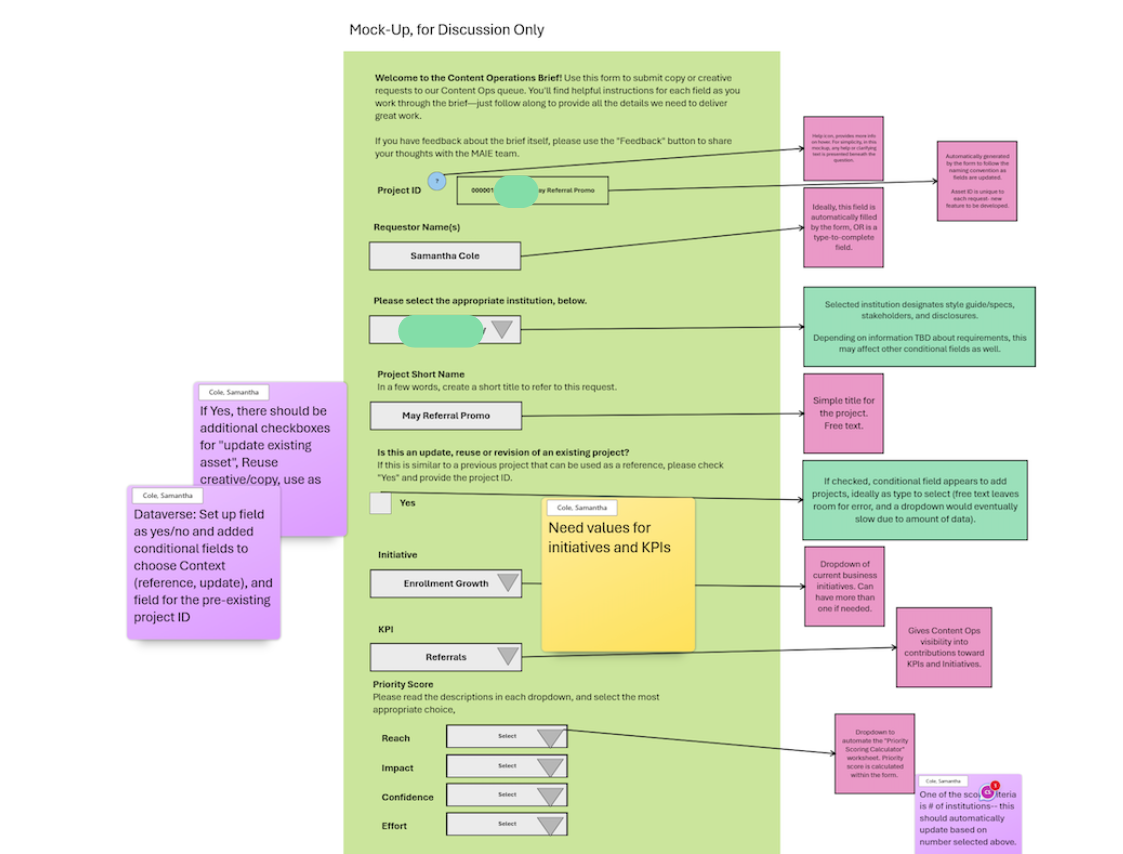
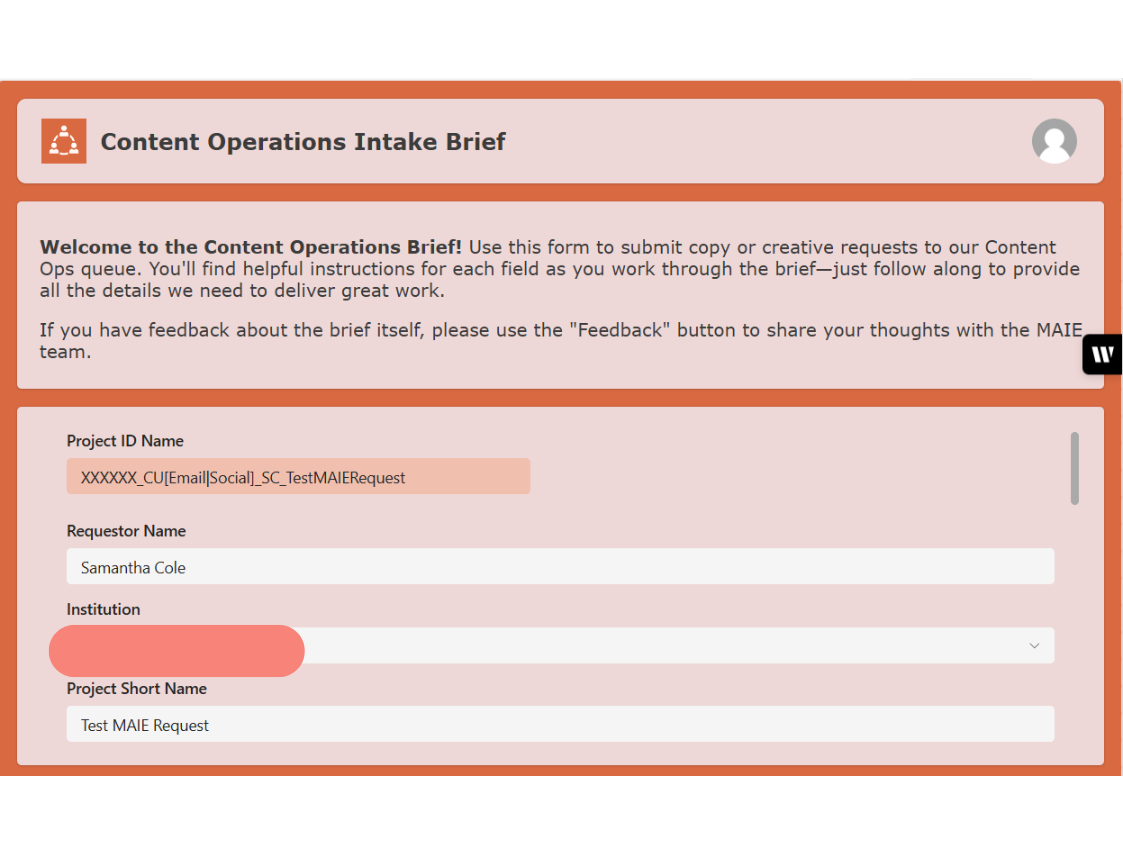
Automatic generation of the naming convention based on user inputs, plus a unique ID generated at brief submission for records.
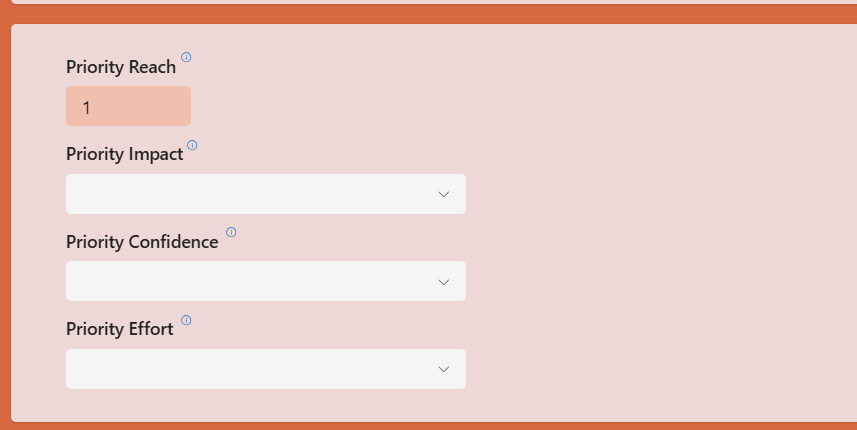
Auto-calculation of the priority score, using the information provided by the CC Ops team for manual calculation. The new brief would calculate the score itself, but also automate certain fields like project scope based on other inputs from the requester. This score was optionally hidden so that requestors could not artificially inflate their priority score.
Standardization of KPI’s or organization-wide initiatives, so that reporting could include the amount of work supporting those metrics.
Standardization of required stakeholders based on inputs like institution or type of asset, so that the appropriate financial or legal approvers would automatically be associated with the project.
With these solutions in mind, I mapped a new process and a proposed intake brief to present to the CC Ops team.
Step 3: Build It
Once the proposal was enthusiastically approved by the CC Ops team, I set off to determine how to build it. After researching our existing tech stack and capabilities, I settled on Microsoft Power Studio. The brief itself would be developed in Power Apps, with the supporting database living in Dataverse, and additional logic capabilities (like the generation of a unique identifier) powered by Power Automate. This would also enable me to further enhance the experience with apps using Copilot Studio more easily as part of the ecosystem, such as a chatbot that users could converse with to complete the brief, or generate reporting on different project metrics.
Selected Platforms:
Microsoft Power Studio (Power Apps, Dataverse, Power Automate, Copilot Studio)
Writer (an agentic AI platform for content creators)
This was my first adventure with Microsoft Power Studio, but through fearless perseverance and a lot of testing and learning, I built the first release in just 2 weeks, with extensive documentation for additional release phases to launch identified optimizations. The first launch included the supporting Dataverse tables and logic, the intake brief application, which included general intake information for any campaigns, and specifics for the email channel, and feedback channels connected to the feedback button in the brief which would automatically trigger a support ticket to my team in the event of challenges with the brief.
The new process accounted for:
A clear, single intake process.
Guided support for the requestor, enabling all necessary information to be provided at project submission.
A flexible brief experience that would automatically adjust to allow inputs based on channels selected, number of creative versions, etc., with an opportunity to scale and support future needs, like inclusion of specific audience segments for targeting within the brief intake process.
Data verification to ensure an accurate brief submission.
Records of each submission in a database that would allow for editing, version control, and reporting.
Automated calculation of needed specifications, like priority scoring and target dates.
AI-enabled QA and feedback channels to all stakeholders, including my team— if there was a challenge that we could solve with further optimization, I wanted it to be surfaced immediately.
AI-powered summarization of the brief that would reformat the brief inputs from the user to a template that made the most sense to CC Ops. This would ensure the optimal user experience for both the requestors and the team receiving the work request.
API connections to support seamless integration into downstream processes, like triggering a project request in Workfront with the brief attached and relevant inputs transposed.
The Results
One of the challenges with this project was the lack of reporting available for pre-existing work. Therefore, it was not possible to generate a benchmark, but A/B testing was planned for the rollout of this new process to get an idea of KPI improvements. This would have included:
Time to market
Rounds of revisions
Production deadlines met vs. missed
Production volume
A net new benefit of this project was the introduction of reporting capabilities in general (with the intention to scale and serve as a source of truth), particularly volume vs. value propositions, volume per channel, or volume by department, which could then be contrasted against success metrics across the business to further advise future efforts.